List
Fire Extinguishers Built for Safety — Backed by Service
Northland Fire proudly supplies and services industry-leading fire extinguisher brands including Ansul and Badger —trusted for their rugged durability and NFPA-compliant performance. We carry extinguishers for every fire class (A, B, C, D & K), with ABC dry chemical being the most commonly used for general protection across homes, businesses, and industrial sites.
We provide full-service fire extinguisher support:
- New Sales and Installs
- Annual Inspections and 6-Year Maintenance
- 24/7 Emergency Support
- Mobile Service to Meet Your Schedule
From retail and healthcare to warehouses and food trucks—if you need fire protection, we’re ready to help. Stay protected. Stay compliant. Contact Northland Fire today.


Testing | Inspection | Recharging
Northland Fire delivers NFPA-compliant annual inspections on-site to ensure your extinguishers are up to code and ready when needed. Our trained technicians also assess your facility to ensure proper placement and coverage.
We offer automatic service renewal, so your business stays protected without the guesswork.
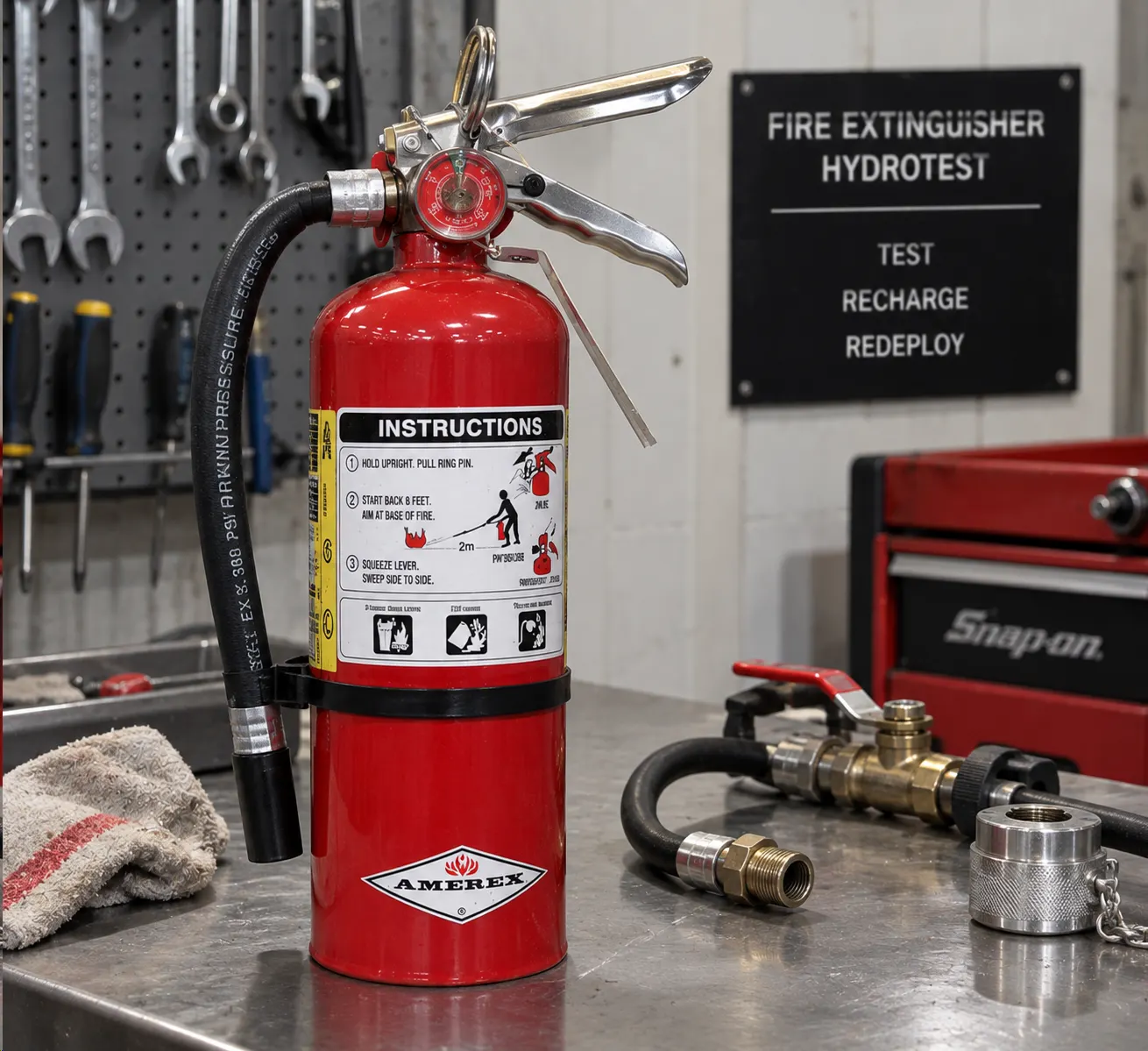
At our DOT-licensed facility, certified shop technicians handle all recharging and hydrostatic testing for both high- and low-pressure extinguishers and cylinders—ensuring safety, compliance, and performance.
What's a Hydro Test?
In addition to annual inspections, fire extinguishers require a 6-year internal visual inspection to check for corrosion or damage inside the cylinder. At 12 years, they must undergo a hydrostatic pressure test ("Hydro Test") to confirm the integrity of the cylinder under pressure. Northland Fire performs both services in-house, keeping your equipment compliant, safe, and fully operational.
Extinguisher Grid
Types of Fire Extinguishers

ABC Dry Chemical - most commonly used fire extinguisher for general-purpose protection. It’s effective on Class A (ordinary combustibles), Class B (flammable liquids), and Class C (electrical) fires. The extinguisher uses a fine, non-conductive powder—typically monoammonium phosphate—that smothers flames and interrupts the chemical reaction of the fire. It's safe, reliable, and ideal for use in homes, offices, vehicles, and commercial spaces.

SENTRY - the most common type of fire extinguisher. When economy and performance are equally important, select from the SENTRY line of stored pressure, hand portable fire extinguishers. Agents include dry chemical, carbon dioxide, and water.

RED LINE - cartridge-operated extinguishers are the premium firefighting units preferred by safety directors in high fire-risk industries. Agents include dry chemicals and powders.

K-GUARD - fire extinguishers contain ANSULEX liquid fire suppressant to quickly knock down the flames, form a vapor-securing blanket, and cool the grease and surrounding surfaces.

CLEAN GUARD - hand portable fire extinguishers contain DuPoint FE-36 where the agent must clean, electrically non-conductive, environmentally friendly, extremely low toxicity and exceptionally effective.

RED LINE WHEELED - extinguishers are designed to protect high fire-risk areas where the potential for large fires exists. Agents include dry chemicals, dry powders, carbon dioxide, and alcohol resistant AFFF. These units are typically used at airports, heavy industrial plants, refineries, pipelines, steel mills, paint spray booths, and manufacturing areas.
MULTIPURPOSE EXTINGUISHERS - Most portable extinguishers are rated for use with more than one classification of fire. For example, an extinguisher with a BC rating is suitable for use with fires involving flammable liquids and energized electrical equipment. An extinguisher with an ABC rating can be used for fires involving ordinary combustibles in addition to the B and C rated fires. An extinguisher that is rated for use with multiple hazards should include a symbol for each hazard type.
Types of Fire

Types of Fires
CLASS A - common combustibles such as wood, paper, cloth, rubber, trash and plastics.
CLASS B - flammable liquids, solvents, oil, gasoline, paints, lacquers and other oil-based products.
CLASS C - energized electrical equipment such as wiring, controls, motors, machinery or appliances.
CLASS D - combustible metals such as magnesium, lithium and titanium.
CLASS K - combustible cooking media such as oils and grease commonly found in commercial kitchens.